The wolf cut on straight hair is one of those styles that looks like it should not work but absolutely does. Most wolf cut content focuses on wavy or curly hair where the layers and the texture naturally reinforce each other, but straight hair produces something completely different and I find it genuinely more interesting in some ways. On straight hair the disconnected layers are visible as actual shapes rather than blending into curl, which gives the cut a graphic, almost architectural quality that feels very deliberate and very current in 2026.
I started paying close attention to wolf cuts on straight hair after noticing how many women were getting the shape but losing the undone quality by over styling it into something too smooth and too polished. The whole point of this cut is that it looks like it has happened to the hair rather than been imposed on it, and on straight hair achieving that quality requires specific choices at the cutting stage and a very light hand when it comes to styling.
These seventeen versions each have a slightly different character, and I kept every description specific enough to take straight to your stylist.
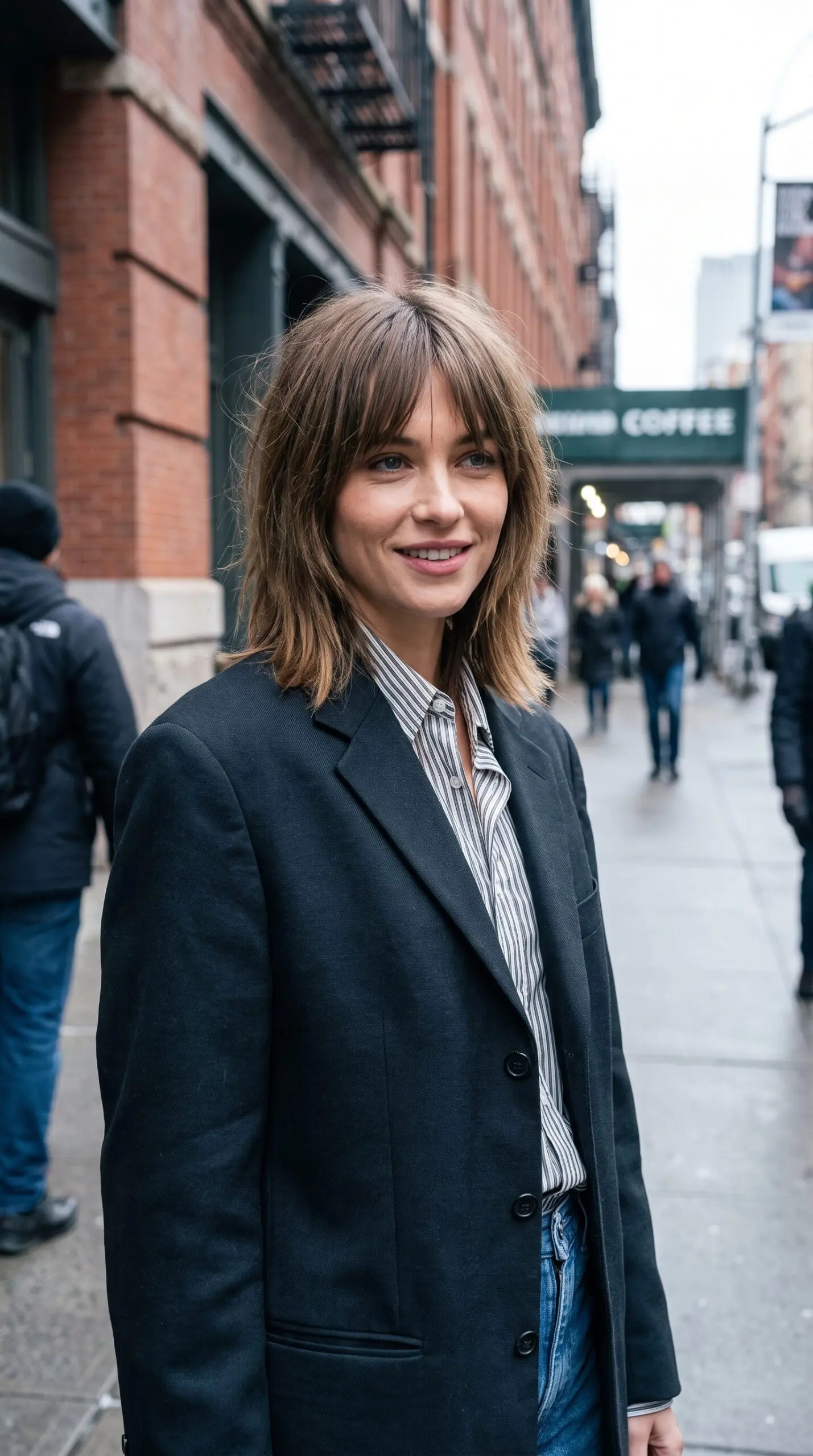
1. Classic Straight Wolf Cut with Curtain Bangs
The classic wolf cut on straight hair features a shorter, rounded layer at the crown that disconnects visibly from the longer layers beneath, with curtain bangs that sweep from a centre part and blend into the face frame. On straight hair the separation between the crown layer and the mid lengths reads as a clean visual line rather than a gradient, which gives the cut a sharper, more graphic version of the wolf shape than most people have seen.

The curtain bangs are what soften that sharpness and bring the face into the picture. Without them the straight wolf cut can look a little severe at the front, since the disconnected layers at the crown can frame the forehead in a way that emphasises rather than softens the face shape. The curtain bangs sweep the emphasis back toward the eyes and cheekbones where it belongs, and the combination of the precise layering and the soft fringe is what makes this version feel simultaneously cool and approachable.
2. Short Straight Wolf Cut
A short wolf cut on straight hair sits around the jaw or just below, with the crown layer significantly shorter than that and the disconnection between the two visible from every angle. At this length the straight texture makes each layer extremely defined, almost like the cut is composed of separate sections of hair that happen to be sitting together rather than one continuous length.

I find the short straight wolf cut is the most wearable version of this style for everyday life because it requires the least maintenance. The shorter length means there is not enough hair to weigh down or lose its shape over the course of a day, and the disconnected layers sit where the cut placed them without needing product to keep them there. Air drying is almost always sufficient, and the undone quality the style is known for comes built into the cut rather than being achieved through any styling technique.
3. Long Straight Wolf Cut
The long version of the straight wolf cut keeps the length past the shoulders while still maintaining the characteristic disconnected crown and heavy internal layering. On straight hair at longer lengths the layers become visible as the hair moves, creating a shifting, dynamic quality that straight hair without layering rarely achieves. When still, the layers are less obvious. In motion they reveal the full complexity of the cut.

This is the version I recommend to women who want the wolf cut’s character but are not ready to lose their length. The long straight wolf cut keeps significant length at the ends while still delivering the volume at the crown and the textured, slightly chaotic mid lengths that define the style. It does require more styling effort than the shorter versions to maintain the undone look without the hair becoming flat and heavy, but a light texturizing spray through the lengths is usually enough.
Tip: Apply texturizing spray to dry hair and scrunch the mid lengths upward gently rather than downward. This lifts the internal layers away from each other slightly and prevents them from clumping together into a flat sheet, which is the main styling challenge of the long straight wolf cut.
4. Straight Wolf Cut with Money Pieces
Adding money pieces, lighter face framing sections at the front, to a straight wolf cut gives the style a colour dimension that the cut alone does not have. On straight hair the money pieces are completely visible from root to tip rather than being broken up by texture, which means they make a stronger visual statement on straight hair than on any other texture.

I prefer subtle money pieces that are two or three shades lighter than the base rather than dramatically bleached strips, because the subtle version looks intentional as it grows out and the stronger version can look harsh once the root comes through. On a straight wolf cut the money pieces should be placed to follow the natural face frame of the curtain bangs or front layers so they sit as part of the cut rather than on top of it.
5. Blunt Ended Straight Wolf Cut
Most wolf cuts rely on point cut or razored ends that taper into softness, but a blunt ended version on straight hair produces something genuinely different. The internal layers are still present and still disconnected, but the ends of each layer are cut straight across rather than thinned, which gives every length section a clean, precise finish. The result is a wolf cut with graphic edges rather than wispy ones.

This version suits women who want the structural interest of the wolf cut without the delicate, slightly fragile quality of very thinned ends. Blunt ends on straight hair sit more solidly and hold their shape longer between cuts than point cut ends do, which makes this version a better choice for women whose hair grows quickly or who do not want to be in the salon every six weeks to maintain the silhouette.
6. Straight Wolf Cut with a Side Part
Moving the part from the centre to a deep side position changes the entire visual weight of the wolf cut on straight hair. The heavier side falls across the forehead and over one eye slightly while the lighter side reveals the disconnected crown layers more clearly, creating a strong asymmetry that gives the already dynamic wolf cut an extra layer of visual interest.

I find the side part wolf cut particularly flattering on oval and longer face shapes where the asymmetry adds width rather than length to the face. The heavier falling side of the wolf cut on straight hair also catches the light differently to the side it falls away from, which means the cut looks dimensional even without any colour variation in the hair.
Check out these 23 Fluffy Wolf Cut Hair Ideas that look Absolutely Trendy
7. Straight Shaggy Wolf Cut
The shaggy wolf cut takes the layering further than the classic version, adding even more internal layers so the ends of each section are thinner and more feathered. On straight hair this produces a cut that looks genuinely lived in and slightly rock influenced, with ends that taper into almost nothing and layers that sit separately rather than stacking against each other.

This is the version I point to when someone says they want their wolf cut to look like a seventies rock musician’s hair rather than a contemporary internet hair trend. The shaggy quality comes from the quantity and aggressiveness of the layering rather than from any styling technique, which means it looks this way when the hair does nothing except exist. That is the definition of an undone look on straight hair.
Tip: Ask your stylist to use a razor rather than scissors for at least the final layer of cutting on a shaggy wolf cut. Razor cutting on straight hair produces feathered, thin ends that scissors cannot achieve at the same speed, and those feathered ends are what make the shaggy version feel genuinely effortless rather than deliberately texturized.
8. Straight Wolf Cut Lob
A wolf cut applied to a lob length, sitting between the chin and shoulder, produces a compact, very wearable version of the style that suits women who want something easier to manage than a longer wolf cut but more interesting than a plain lob. The disconnected crown layer at lob length creates a clear silhouette difference between the top and the lengths that still reads as a wolf cut rather than just a heavily layered mid length.

I find the wolf cut lob is the single most practical version of this style for daily wear. It dries quickly, holds its shape without much intervention, transitions easily between styled and unstyled, and the shorter overall length means any imprecision in the layering is less visible than it would be at longer lengths. It is a good starting point for anyone who is new to the wolf cut and wants to try the shape without a long term commitment.
Image prompt: A woman with a straight wolf cut lob between the chin and shoulder, the crown layer clearly shorter and disconnected, wearing a cream knit jumper, photographed in a bright kitchen in natural morning light, realistic everyday portrait photograph.
9. Straight Wolf Cut with Wispy Ends
Wispy ends are achieved by aggressively point cutting or razoring the tips of each layer so they taper to almost nothing. On straight hair this technique produces ends that catch light individually rather than as a block, giving the cut a delicate, slightly fragile quality that contrasts interestingly with the structural boldness of the disconnected layers above.

I find wispy ends on straight wolf cuts particularly good in finer hair where the lightweight tips prevent any single layer from sitting too heavily against the layers beneath it. The individual strands are visible rather than clumping, and that visibility is what gives the style its airy, undone quality. Wispy ends do require more frequent trims than blunt ends since they can look scraggly as they grow rather than simply longer.
10. Straight Wolf Cut with Fringe
A full blunt fringe on a straight wolf cut gives the front of the style an entirely different character to the curtain bang version. The fringe sits straight across the forehead as a clean horizontal line while the disconnected wolf layers continue behind it, creating a combination of a very precise element at the front and a more deliberately chaotic structure behind. The contrast between the two is what makes it interesting.

I specifically like this version on women with naturally straight, heavy hair because the blunt fringe cuts through the weight of the hair in a way that does not require any additional styling to look deliberate. The fringe stays straight and flat on straight hair without needing to be blow dried into submission every morning, which is one less step that a busy day does not have room for.
11. Straight Wolf Cut on Fine Hair
Fine straight hair and the wolf cut are a better combination than most people assume. The layering removes weight from a cut that on fine hair without layers can fall completely flat by midday, and the disconnected crown layer in particular adds volume at the top of the head where fine hair needs it most. The undone quality of the wolf cut also suits fine hair more honestly than very structured cuts that require fine hair to look fuller than it is.

I find fine hair wolf cuts benefit from slightly less aggressive layering than the same cut on thicker hair, since removing too much weight from fine hair can make the ends look sparse rather than airy. The goal is to take enough weight out that the layers move independently without taking so much that individual hairs are visible in the lighter sections. That balance point is specific to each person’s hair density and a good stylist will calibrate it accordingly.
12. Straight Wolf Cut on Thick Hair
Thick straight hair and the wolf cut work together because the heavy internal layering of the wolf cut removes exactly the kind of bulk that thick straight hair tends to accumulate. Without the aggressive layering, thick straight hair at most lengths sits as a solid, slightly impenetrable mass. With the wolf cut’s disconnected layers it suddenly has movement, lightness, and a structure that looks intentional.
On very thick straight hair I would ask specifically for the underneath layers to be thinned significantly, not just point cut at the ends but thinned from the interior using thinning shears through the body of each section. This is more aggressive than most wolf cut techniques but on genuinely thick straight hair it is what allows the upper layers to sit correctly rather than being pushed outward and upward by the volume below.

Tip: After the cut, avoid heavy oils or serums on thick straight wolf cut hair. Products that add shine and weight are counterproductive on this style since they pull the layers back together and eliminate the separation that the cut was designed to create. A light misting of texturizing spray is all the product thick straight wolf cut hair usually needs.
13. Collarbone Length Straight Wolf Cut
A wolf cut sitting precisely at the collarbone has a very specific quality on straight hair. The collarbone acts as a natural resting point for the longest layers, and when those layers end exactly there the cut looks intentionally measured rather than incidentally at that length. The crown layers sit significantly higher, the mid lengths graduate between the two, and the collarbone ends anchor the whole silhouette.

I find this version particularly good in professional settings where the wolf cut’s more dramatic shorter versions might feel too casual. The collarbone length reads as a proper haircut rather than a style experiment, while the internal layering and disconnected crown still deliver the undone character that makes the wolf cut worth having. It is the version I recommend to women who love the style but work in environments where hair is expected to look considered.
14. Straight Wolf Cut with Highlights
Highlights running through a straight wolf cut map exactly onto the layering structure of the cut because the different lengths of each layer catch the highlights at different points. The result is that the colour looks like it is moving with the cut rather than sitting in the hair independently, which creates a dimensional effect that is hard to achieve with highlights on straight unlayered hair.

I prefer a balayage application for highlights on a straight wolf cut rather than traditional foils, since the painted application follows the fall of each layer and the colour lands where the layer sits naturally rather than at predetermined foil positions that may not align with the cut’s structure. The highlights then read as an extension of the cut rather than something applied over it.
15. Straight Wolf Cut Grown Out
A wolf cut that has grown for two or three months without being reshaped develops its own character on straight hair. The aggressively disconnected layers begin to reconnect slightly as the lengths approach each other, the wispy ends gain a little more weight, and the overall shape softens from the precise original version into something that looks more organic and more genuinely undone than the fresh cut.

I think the grown out straight wolf cut deserves recognition as a style in its own right rather than a stage between appointments. On straight hair specifically the grown out version has a softness that the freshly cut version lacks, since the precision of the original cut blurs into something more natural over time. Women who feel ambivalent about their wolf cut two months in are often wearing one of the best versions of it without realising.
16. Straight Wolf Cut with Dark Roots
Dark roots left natural or grown out through a lighter straight wolf cut add a colour depth that plays specifically well with the layering structure. As each layer moves and catches different amounts of light, the darker roots at the top of each section and the lighter ends below create a colour gradient that shifts constantly. On straight hair where the layers are distinct rather than blended, this effect is more visible and more interesting than on textured hair.

I find the dark root wolf cut on straight hair is one of the most genuinely low maintenance colour looks available because it requires absolutely nothing to maintain. As the roots grow the effect only becomes more pronounced, and the distance between the root colour and the ends can be extended almost indefinitely before the grow out looks neglected. It suits women who want colour interest without the commitment of regular colour appointments.
17. Effortless Air Dried Straight Wolf Cut
The final version on this list is about what the straight wolf cut does when you do absolutely nothing to it after washing. Washed, conditioned, left to air dry completely without product or heat, the straight wolf cut on most hair types produces a naturally slightly wavy or textured result from the layering itself, since the different lengths dry at different rates and with slightly different amounts of natural movement.

I think this is the most honest version of the style and the truest expression of what the wolf cut on straight hair is actually designed to do. When it is cut well enough to need nothing from you, that is the real test of whether the cut is working. Not every straight wolf cut passes that test, but the ones that do have a naturalness and a confidence to them that no amount of styling product can replicate. If I could only recommend one version from this entire list for everyday life, it would be this one.
Final thoughts
The straight hair wolf cut in all seventeen versions comes back to the same essential principle: the undone quality is built into the cut, not applied on top of it. When the layering is right, when the disconnection between the crown and the lengths is calibrated correctly for the specific hair density and texture, the style requires almost nothing from you to look exactly as it should. That is what separates a good wolf cut on straight hair from a mediocre one, and it is what makes finding the right stylist for this particular cut worth the effort.
If you are getting your first wolf cut on straight hair, the most useful thing you can bring to the appointment is a reference image of the version from this list that matches your hair’s natural behaviour. Not an aspirational image of a completely different texture, but something that honestly reflects what your straight hair actually does. The cut works best when it is designed for the hair that is actually sitting in the chair.