I was twelve years old the first time I saw a pop star with chunky spiky hair on a magazine cover and immediately went home and tried to recreate it with my mother’s hairspray. The result was not what I had in mind, but I was completely hooked on the energy of it. That specific Y2K spiky aesthetic, bold, slightly reckless, completely unafraid of itself, is back in a way that feels genuinely exciting rather than nostalgic for nostalgia’s sake. In 2026 these styles carry a confidence that lands differently on grown women who actually remember wearing them the first time around.
What I love about spiky Y2K hairstyles specifically is that they work across a range of lengths and textures in ways that most people do not realise. You do not need waist length hair or a specific face shape. You need the right technique, the right product hold, and a willingness to commit to the look rather than hedging it into something safer. These seventeen versions cover the full range of what spiky Y2K hair can actually look like in 2026, and I kept every description specific enough that you can take it to your stylist or recreate it at home.
1. Chunky Spiky Pixie
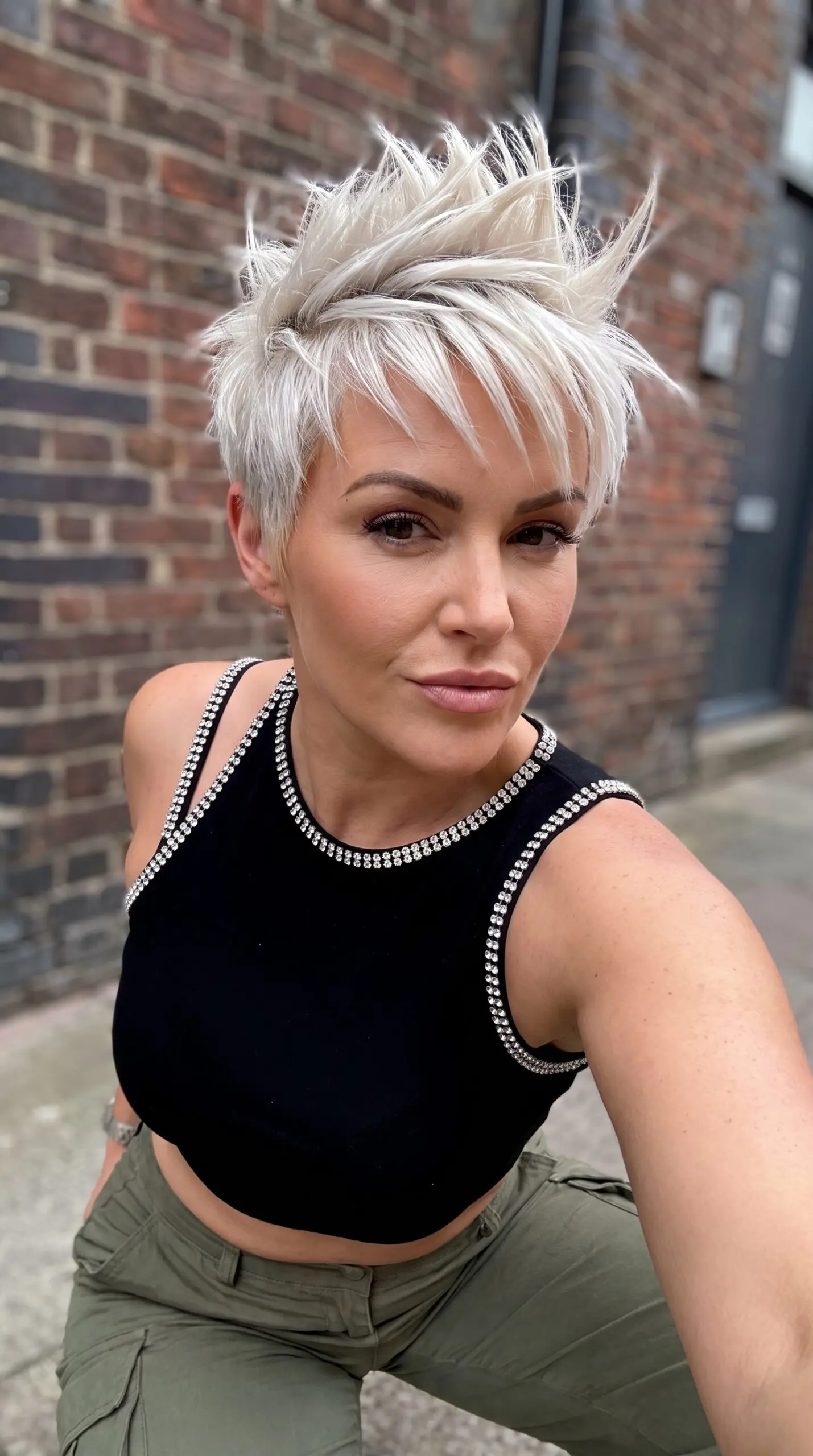
The chunky spiky pixie is the most direct translation of Y2K energy into a short haircut. The hair is cropped close at the sides and nape while the top section is left long enough to sculpt into thick, separated spikes that point upward and forward. Each spike is genuinely chunky rather than fine and needle like, which is what separates the Y2K version from a generic short spiky cut.

I find this works best on hair with a bit of natural grip or texture rather than very fine, silky hair that refuses to hold a spike without constantly reapplying product. The styling process involves separating the top section into roughly five or six sections, applying a strong hold wax or pomade through each section, and then pinching and twisting each one upward into a defined point. Once set, the spikes stay in place for a full day without touching, which is exactly the kind of low maintenance commitment the style deserves.
Tip: Use your fingers rather than a comb to create the sections before spiking. Comb lines are too neat and produce spikes that look uniform and stiff. Finger separated sections have slight variation in size and direction that makes the spikes look more organic and more genuinely Y2K.
2. Half Up Spiky Buns
Two small spiky buns sitting high on either side of the head, with the lower half of the hair left loose, is one of the most recognisable Y2K hairstyle silhouettes. I wore a version of this to every school dance between 2001 and 2004 and the fact that it is back does not surprise me at all. The combination of something structured and something loose in the same style has a playful energy that nothing else quite replicates.

The buns work best when they are not perfectly round. A slightly messy, slightly pointy bun on each side reads more authentically Y2K than a smooth spherical version. I build each one by gathering a small high section, wrapping it loosely, and then pulling individual pieces from the surface upward so the overall shape has texture and direction rather than looking tidy. The loose hair underneath can be straight, wavy, or crimped depending on how much commitment to the era you want.
Love Space Buns? Check these 13 Romantic Messy Bun Hairstyles for Brides and Events
3. Spiky Ponytail
A high ponytail with the tail itself sculpted into multiple separated spiky sections rather than hanging smooth is a Y2K look that works on longer hair without requiring a significant cut. The ponytail is gathered as high as it can go, secured tightly, and then the tail is divided into several sections which are each coated in strong hold gel and twisted or pinched into defined points that shoot outward in different directions.

I find the spiky ponytail particularly impressive in motion because the spikes hold their individual positions while the ponytail as a whole moves with the head. It looks much more complex than it is. The most important product decision is using a gel with strong hold rather than wax, since wax can be too heavy for a high pony where gravity is working against the style. A strong gel dries hard and the spikes literally stay put without any additional support.
4. Spiky Crimped Half Up
Crimping is one of the most underused Y2K techniques in the 2026 revival, and combining it with a spiky half up gives you a style that packs two of the era’s biggest hair moments into a single look. The top half is gathered into a half up and then sculpted into a cluster of forward pointing spikes, while the lower half is crimped throughout so the loose hair has that distinctive zigzag texture that defined so much Y2K styling.

Getting the crimper to produce tight, defined crimps rather than loose, barely there waves requires working in small sections and holding the crimper in place for two to three seconds per section rather than moving quickly. I always start at the underneath sections and work upward so the sections on top are freshly crimped and the most visible. The contrast between the precise spiky structure at the top and the wild crimped texture at the bottom creates a really specific kind of energy that I find irresistible.
5. Spiked Tips on a Bob
Rather than sculpting the whole head of hair into spikes, this version applies the spiky treatment only to the tips of a chin length bob. The body of the bob sits smooth or slightly textured, and the ends are separated and pointed outward and downward so the perimeter of the bob has a graphic, almost crown like spiky edge. It is the most wearable version of spiky hair on this entire list.

I recommend this to anyone who loves the Y2K spike aesthetic but works in an environment where a fully spiky style might read as too casual. The spiked tips bob reads as a deliberate styling choice at a glance, which it is, but the overall silhouette of the bob is still there and still professional looking from a distance. Up close the spiked tips are the whole personality of the cut. Wax or pomade applied directly to the tip sections and then pinched into points is all it takes.
6. Spiky Space Buns
Space buns already exist at the intersection of Y2K and current styling, but the spiky version takes them decisively into Y2K territory by pulling pieces from the surface of each bun and pointing them outward and upward so the buns have texture and edge rather than being smooth and round. Each bun becomes a small explosion of structured pieces rather than a tidy gathered circle.

I build spiky space buns by gathering each side section into a high ponytail, twisting the length loosely, wrapping it into a bun shape, and then securing it and deliberately pulling pieces free from the surface and pointing them using a small amount of wax between my fingers. The result looks like the bun was put up in a hurry and then the ends refused to cooperate, which is entirely the right impression for a Y2K style to give.
Tip: Do spiky space buns on second day hair rather than freshly washed. Clean hair is too slippery for the spiked pieces to hold their positions without excessive product. Day old hair has enough natural texture to hold a spike with a minimal amount of wax, which produces a cleaner result and a lighter feeling style.
7. Spiky Fringe on Straight Hair
A blunt straight fringe with the tips of the fringe separated and spiked downward toward the forehead is a very specific Y2K look that I do not see enough of in the revival content. The fringe sits as a solid mass across the forehead but the tips are divided and pointed, creating a fringe that looks simultaneously blunt and spiky. It requires enough fringe thickness to divide into meaningful sections without each one looking sparse.

On straight hair this works particularly well because the body of the fringe holds its straight shape naturally while the spiked tips, applied with gel or wax, stay pointed independently. The contrast between the flat blunt body of the fringe and the separated spiked tips is what makes this version interesting. On wavy hair the fringe body would need to be straightened first, which adds time that the fringe-on-straight-hair version does not require.
8. Full Head Gel Spiked Look
This is the version that leaves nothing behind. Every section of hair across the entire head is coated in strong hold gel, separated, and sculpted into defined spikes pointing in various directions from the crown outward. It is the most committed version of Y2K spiky hair and the one that requires the most product and the most confidence to wear, which also makes it the most memorable.

I would not attempt this version for the first time on a day when anything matters. It takes practice to get the sections separated evenly enough that the overall effect reads as deliberate rather than random, and it takes practice to use exactly enough gel so the spikes hold without the whole head looking wet and product laden. Once you have the technique, though, this is the version that gets stopped on the street. It has that kind of presence.
9. Spiky Mohawk Inspired Style
Gathering all the hair from the sides toward the centre and sculpting the central strip into a row of defined spikes gives a mohawk inspired shape without requiring any shaving or undercut. The sides are smoothed flat or pinned back while the centre strip stands as a series of individual spikes from the forehead to the nape. On longer hair the spikes at the crown can be dramatically tall while the spikes toward the forehead and nape are slightly shorter to follow the natural curve of the head.

I find this version works best on hair that has at least six inches of length at the crown, since the spikes need enough hair to form properly without toppling under their own weight. Strong hold gel applied through each spike section and then blow dried upward is the most effective technique for achieving genuine height here, since product alone without heat tends to produce spikes that droop by midday. The blow dry sets the shape, and a final light mist of hairspray locks it.
Tip: When blow drying spikes upward for a mohawk inspired look, always point the nozzle upward from below the spike rather than downward from above. Blowing from below pushes the spike up and sets it in the lifted position. Blowing from above pushes it down and defeats the whole purpose.
10. Spiky Top with Sleek Sides
The contrast between a spiky, textured top section and completely smooth, sleek sides is a Y2K combination that has aged remarkably well. The sides are blow dried smooth and flat against the head while the top section, left longer, is separated and spiked upward. The contrast between the two zones is what makes the style feel designed rather than just styled, and the clean sides keep it from looking too chaotic in contexts where that matters.

I think of this as the Y2K spiky style for women who want the aesthetic but prefer a more structured overall shape than the full head spiked or shaggy versions provide. The sleek sides impose an order that the spiky top plays against, and the combination reads as intentional in a way that a uniform spiky all over look sometimes does not. Straightening serum on the sides and strong hold wax on the top, applied separately, gives each zone exactly what it needs.
11. Spiky Updo with Escaping Pieces
A gathered updo where individual pieces have been deliberately pulled free and then spiked upward and outward from the main shape is the Y2K version of a formal updo. The base is secured at the crown or back and the overall structure reads as an updo from a distance, but individual spiked pieces escape from the surface and the perimeter in ways that make the style look like it is coming undone in the most energetic way possible.

I love this version for events or occasions where a full updo is expected but a completely conventional one feels too restrained. The spiked pieces add a rebellious detail to a shape that would otherwise be very tidy, and the contrast between the gathered structure and the escaping spikes is where the style’s personality lives. Wax on the individual pieces after the updo is secured gives each escaped strand enough hold to point deliberately rather than just frizz.
12. Spiky Pigtails
Two low or mid height pigtails where each tail is divided and spiked rather than hanging smooth is a look that sits very specifically in the Y2K era and nowhere else, which is exactly why I love it for this list. The pigtails are gathered at a medium height on each side, secured, and then the tails are separated into five or six sections and each section is pinched into a spike using gel or wax. The result looks something like two small fireworks on either side of the head.

The height of the pigtail changes the whole character of the style. Very high pigtails read as more playful and exaggerated. Mid height pigtails read as more wearable and versatile. I prefer the mid height version for most occasions because it strikes a balance between commitment to the Y2K reference and actual wearability through a full day, but the very high version is the right choice for anything where the point is to go fully into the aesthetic.
13. Spiky Ends on a Wavy Base
Using a curling iron or natural waves as the base of a style and then spiking just the ends of each curl creates a look that is textured throughout but spiky specifically at the tips. It is a softer entry point into the Y2K spike aesthetic than the gel heavy versions, since the wave provides movement and dimension while the spiked ends give the style its era specific edge.

I find this version requires the least product of any style on this list, since the wave itself does most of the structural work and only the very tips need to be spiked with wax. This makes it comfortable to wear for longer periods and easier to adjust if any single spike loses its shape during the day. It also works beautifully on naturally wavy hair with no additional styling of the wave section at all, which makes the getting ready time genuinely quick.
14. Flat Twisted Spikes at the Hairline
Small, flat twisted spikes created right at the hairline, specifically at the temple and forehead edge, while the rest of the hair remains loose or gathered, is a Y2K detail that reads as deliberate and specific rather than as a full hairstyle commitment. The twists are formed by taking small sections, applying gel, twisting tightly, and then flattening each twist against the hairline so it sits as a defined spiral or pointed shape right at the edge of the face.

I recommend this version to women who want a reference to the Y2K spike aesthetic without wearing their entire head in it. The hairline twists are visible when you are looking at the face, which is most of the time, and the rest of the hair can do whatever it naturally does. It also works exceptionally well as a detail to add to a ponytail, bun, or any other gathered style where the face framing area might otherwise look plain.
15. Short Spiked Bob with Undercut
A short bob with an undercut at the nape and sides, and the remaining top and front sections sculpted into forward pointing and upward pointing spikes, is the most structured and the most specifically cut Y2K style on this list. The undercut removes the visual weight at the sides and nape so the spiked sections at the top have nothing to compete with and all the attention goes exactly where the styling directs it.

This version requires a salon visit to establish the undercut correctly, and I would not attempt it as a DIY project. The undercut depth and the length left for spiking need to be calibrated together so the spiked sections are long enough to form defined spikes without being so long that they lose height under their own weight. Once the undercut is established, the spiking is done at home with strong hold wax and a fingers only styling technique.
16. Y2K Spiky Hair with Butterfly Clips
Butterfly clips belong to the Y2K era as much as the spikes do, and combining the two in the same style leans into the era with both hands. The hair is partially gathered with multiple butterfly clips at different points on the head while the sections between the clips are sculpted into small upward spikes. The clips hold some sections down while the spiked sections between them reach upward, creating a rhythm of flat and spiked across the whole head.

I think of this as the maximalist version of Y2K hair, which means it is the most fun and the most commitment. The butterfly clips should be in at least two or three different colours to match the era’s attitude toward accessories, and the spikes between them should be defined enough to read clearly from a distance rather than looking like the clips simply pushed the hair upward by accident.
Tip: Secure the butterfly clips last, after the spikes are set. Setting the spikes first with product and then adding the clips means the clips are going into styled hair that already holds a shape. Adding clips to unstyled hair and then trying to spike around them is significantly harder and produces a less clean result.
17. Sleek Low Ponytail with a Spiked Crown
The final version on this list is my favourite for its specific combination of controlled and rebellious. The back and sides of the hair are gathered smoothly into a low sleek ponytail at the nape while the crown section, left free from the ponytail gathering, is sculpted into a cluster of forward pointing spikes. The smooth ponytail reads as polished from behind and the spiked crown reads as entirely something else from the front.

I love this version because it gives you two different impressions of the same style depending on the viewing angle. From the front the spiked crown is the whole story. From behind the smooth low ponytail takes over. It is a style that surprises people when they see the full picture, which is exactly the kind of detail that makes a hairstyle memorable. Strong hold gel for the ponytail, wax for the spikes, and they stay completely in their own zones for the whole day.
Final thoughts
What strikes me looking across all seventeen of these styles is how much range the Y2K spiky aesthetic actually contains. From the wearable spiked tips bob to the fully committed full head gel spikes, from the playful spiky pigtails to the event ready spiky updo, the spike is really a technique that can be applied at different intensities and in different contexts rather than one specific look. The era’s spirit is in the intention, the willingness to make the hair do something visible and deliberate, not in any single silhouette.
If you are new to spiky Y2K styling, start with the spiked tips bob or the face framing hairline twists and work from there. If you already know you are committed, go straight to the full head gel spikes or the mohawk inspired version and do not look back. The one thing all seventeen share is that they require you to actually commit to the look, and that commitment is what makes every single one of them work.